


Why Contractor Partner Taxes in Jakarta Are Extremely Critical?
The construction sector in Jakarta serves as the backbone of the capital city’s development. From toll road infrastructure projects, high-rise buildings in the SCBD area, to the revitalization of Kota Tua, contractors and their partners manage transactions worth billions of rupiah every day. Behind these substantial figures lies a set of tax obligations that must not be overlooked.
Taxation for Jakarta contractor partners covers several tax types simultaneously, ranging from Income Tax (PPh) Article 23, Value Added Tax (VAT/PPN) on construction services, to PPh Article 4 Paragraph (2), which is final in nature. Errors in managing these taxes can lead to administrative sanctions, fines, and even a ban from participating in government project tenders.
This article was prepared based on the direct experience of PT Global Jaya Consulindo in assisting dozens of contractor clients and their partners across the Jakarta, Bogor, Depok, Tangerang, and Bekasi (Jabodetabek) areas. All information refers to the latest tax regulations applicable in Indonesia as of 2025.
Who Counts as a “Contractor Partner” in the Tax Context?
Before diving into tax technicalities, it is essential to understand who actually falls into the contractor partner category from the perspective of Indonesian tax law.
A contractor partner is a business entity—whether a Limited Liability Company (PT), Commanditaire Vennootschap (CV), or individual—that provides services or goods to a construction firm (main contractor). In Jakarta project practices, these partners generally manifest as:
-
Specialized subcontractors — for example, Mechanical, Electrical, and Plumbing (MEP) vendors for office building projects in South Jakarta.
-
Material suppliers — providers of readymix concrete, steel rebar, or ceramics for residential projects in East Jakarta.
-
Labor service providers — labor outsourcing firms supplying workers, foremen, or heavy equipment operators.
-
Supporting consultants — interior design firms, geotechnical consultants, or surveyors working under the main contractor.
Each of these categories receives distinct tax treatments, which often becomes a point of confusion for construction business owners in Jakarta.
Types of Taxes for Jakarta Contractor Partners
PPh Article 23: Tax Withholding on Services
PPh Article 23 is a tax withheld by the main contractor (acting as the withholding agent) when making payments to partners for services rendered.
Applicable rates:
Important note for Jakarta partners: The 2% rate applies provided the partner holds an active Taxpayer Identification Number (NPWP). Without an NPWP, the rate doubles to 4%. This serves as a strong incentive for all contractor partners in Jakarta to maintain an active NPWP.
PPh 23 withheld by the main contractor must be remitted to the state treasury no later than the 10th of the following month and reported via the Monthly PPh 23 Return no later than the 20th of the following month.
PPh Article 4 Paragraph (2): Final Tax on Construction Services
This is the most distinct tax type in the Indonesian construction industry and a critical concept for every contractor partner in Jakarta.
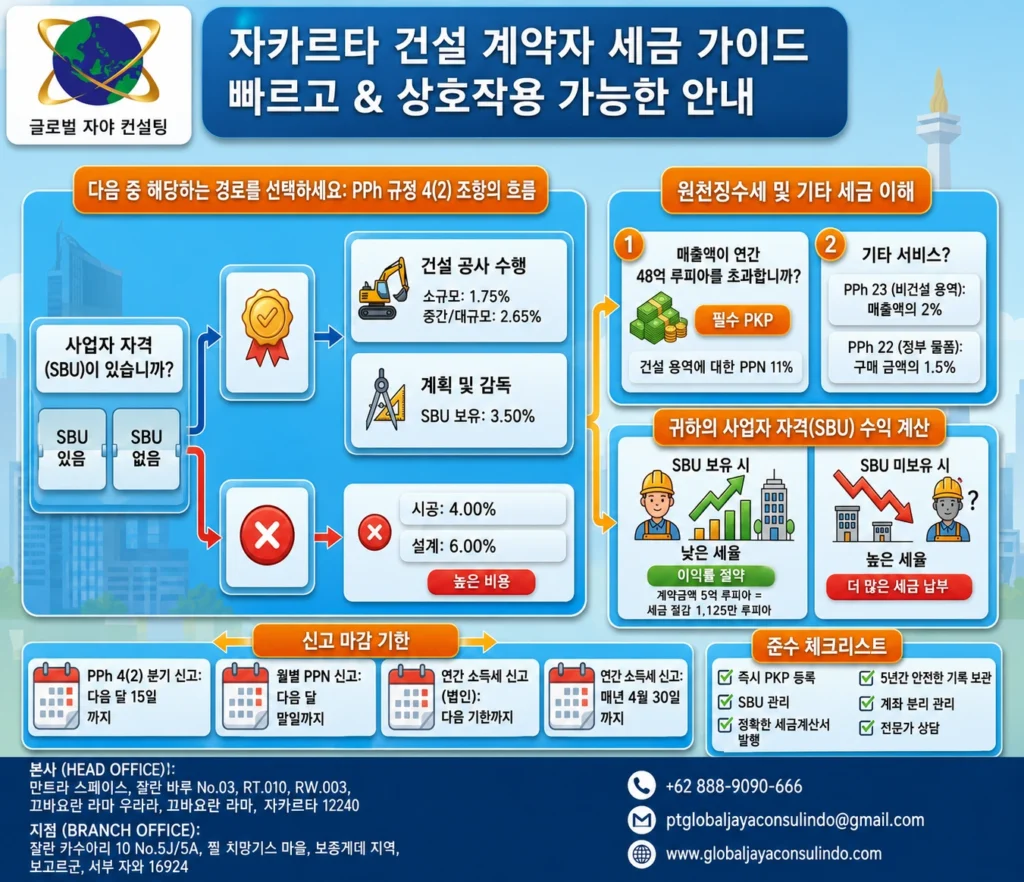
Based on Government Regulation (PP) No. 9 of 2022, Final PPh rates for construction services are as follows:
Direct implication in Jakarta: Construction firms lacking a Business Entity Certificate (SBU) from the LPJK (Construction Services Development Board) face significantly higher final tax rates. This rate difference can substantially impact project profit margins, particularly for tenders in major business hubs like Central Jakarta, South Jakarta, or DKI Jakarta Provincial Government infrastructure projects.
VAT (PPN) on Construction Services
Under the Tax Harmonization Law (UU HPP) and relevant Ministry of Finance Regulations (PMK), construction services are generally subject to an 11% VAT rate. However, specific exemptions and special rates apply:
-
Construction services for simple apartment towers (rusun), simple houses, and low-cost housing receive a 0% VAT facility (exempted).
-
Construction services carried out for government-designated national disasters are granted VAT exemptions.
-
Commercial projects in Jakarta—such as office buildings, shopping centers, and hotels—are subject to the full 11% VAT.
Contractor partners designated as Taxable Enterprises (PKP) are required to issue a Tax Invoice (Faktur Pajak) for every service transaction billed to the main contractor.
Corporate Income Tax: Annual Partner Obligations
Beyond transactional taxes, all contractor partners operating as corporate entities (PT/CV) in Jakarta remain obligated to file an Annual Corporate Income Tax Return (SPT Tahunan PPh Badan) at the standard rate of 22% (effective since the 2022 tax year).
Partners with an annual turnover under IDR 4.8 billion can take advantage of the MSME final tax scheme at a rate of 0.5% of gross revenue under PP No. 55 of 2022.
Administrative Obligations of Contractor Partners in Jakarta
Every business entity partner is required to possess an NPWP. Once annual turnover exceeds IDR 4.8 billion, the partner must register as a PKP to collect, remit, and report VAT.
The process of NPWP registration and PKP confirmation for business entities in Jakarta is handled through the Tax Office (KPP) corresponding to the company’s domicile, such as KPP Pratama Jakarta Kebayoran Lama, KPP Pratama Jakarta Mampang Prapatan, or other KPPs within the DKI region.
Periodic Tax Return Reporting
Jakarta contractor partners with PKP status are required to report:
-
Monthly VAT Return — by the end of the following month at the latest
-
Monthly PPh 21 Return (if employing staff) — by the 20th of the following month at the latest
-
Monthly PPh 23 Return (if withholding taxes from lower-tier partners) — by the 20th of the following month at the latest
e-Faktur Requirement
Partners with PKP status must use the official e-Faktur application provided by the Directorate General of Taxes (DJP) to issue Tax Invoices. Manual tax invoices are no longer permitted and are considered invalid.
Real-World Challenges for Contractor Partners in Jakarta
Based on PT Global Jaya Consulindo’s experience assisting contractor clients in Jakarta, the following tax issues are most commonly encountered in the field:
Issue 1: Invoicing Without Proper Tax Calculations
Many partners, particularly mid-scale subcontractors in Jakarta, issue invoices without correctly calculating the VAT component. As a result, the main contractor cannot claim Input Tax credits, leaving the partner vulnerable to tax adjustments during audits.
Issue 2: Misidentifying PPh 23 vs. Final PPh Objects
Confusion frequently arises regarding whether a service falls under PPh 23 or Final PPh Article 4 Paragraph (2). Incorrect withholding can lead to tax overpayments or underpayments, incurring administrative interest penalties of 2% per month.
Issue 3: Inactive or Misclassified SBUs
Contractor partners whose SBU has expired or does not match the specific scope of work will automatically be categorized as “uncertified” for tax calculations. This causes their Final PPh rate to jump from 1.75% to 4%—more than double the standard rate!
Issue 4: Misunderstanding the PKP Threshold
Partners whose turnover exceeds IDR 4.8 billion but fail to register as a PKP face risks of ex-officio tax assessments, fine penalties, and potential tax audits by the DJP.
Tax Compliance Strategies for Jakarta Contractor Partners
Sound tax management is not merely about avoiding penalties—it is about establishing a credible business reputation, especially for partners aiming to join high-value DKI Jakarta government or state-owned enterprise (BUMN) tenders.
Here are the key strategic steps recommended:
-
First, ensure complete and active business legality. An active NPWP, a Business Identification Number (NIB) via OSS, and a valid SBU form the three core requirements that directly dictate applicable tax rates.
-
Second, maintain separate operational and tax bank accounts. This simple yet effective practice ensures funds are readily available for monthly tax payments without disrupting project operational cash flow.
-
Third, utilize proper accounting systems. Jakarta contractor partners can no longer rely on manual bookkeeping. Accounting software such as Accurate Online or Jurnal.id can automate tax calculations and generate reports that meet DJP standards.
-
Fourth, plan taxes early at the contract stage. Before signing an agreement with the main contractor, perform a comprehensive tax simulation covering Final PPh, VAT, and any potential taxes withheld by the client.
-
Fifth, engage experienced tax consultants in Jakarta. The complexity of construction taxation requires professional guidance, particularly during tax audits or disputes with the DJP.
Impact of DKI Jakarta Infrastructure Projects on Partner Tax Obligations
As the economic center, Jakarta continues to channel massive infrastructure investments into major projects such as:
-
The extension of MRT Jakarta Line Phase 3 (Cikarang–Balaraja)
-
Waterfront City developments along Jakarta’s northern coastline
-
Revitalization of the Tanah Abang and Pasar Baru areas
-
Commercial building developments along the TB Simatupang, Sudirman–Thamrin, and Kelapa Gading corridors
…all of which involve hundreds of contractor partners obligated to fulfill their tax duties accurately and promptly.
Tax offices across Jakarta actively monitor partners involved in these major initiatives. Non-compliant partners risk being blacklisted by the Ministry of Finance, effectively barring them from future government tenders.
SBU Certification and Its Direct Impact on Contractor Tax Rates
As highlighted earlier, holding a Business Entity Certificate (SBU) directly impacts the Final PPh rate borne by contractor partners in Jakarta. It serves not just as a formality, but as a legal mechanism for tax optimization.
Concrete calculation example:
A subcontractor based in East Jakarta executes a project valued at IDR 2 billion.
-
With a small-qualification SBU: Final PPh = 1.75% × IDR 2 billion = IDR 35 million
-
Without an SBU: Final PPh = 4% × IDR 2 billion = IDR 80 million
The difference amounts to IDR 45 million on a single project alone. Consider the cumulative financial impact across 5 to 10 projects per year.
PT Global Jaya Consulindo offers processing services for Construction SBUs and Electrical Power Support Services SBUs (SBU JPTL) for contractor partners in Jakarta and Jabodetabek, helping clients access lower tax rates while satisfying licensing criteria for large-scale projects.
FAQ: Frequently Asked Questions by Jakarta Contractor Partners
Q: Are subcontractors required to withhold PPh 23 from daily freelance workers?
A: No. PPh 23 applies only to payments made to business entities or individuals providing specific qualifying services. For daily freelance laborers, PPh Article 21 applies under the daily wage scheme, withheld directly by the employer.
Q: How are tax obligations treated when a partner receives an advance payment from the main contractor?
A: Advance payments represent part of the contract value and require VAT tax invoices to be issued upon receipt of payment (rather than upon project completion). Final PPh is also due when the payment is disbursed by the main contractor.
Q: Should a partner operating a project in Jakarta but domiciled in Bekasi file taxes in Jakarta?
A: No. Tax filing obligations follow the company’s registered domicile or NPWP address, not the physical location of the project. However, the project location remains relevant for local taxes (such as land acquisition tax or local fees).
Q: What happens if the main contractor forgets to withhold PPh 23 from payments to a partner?
A: Withholding responsibility rests with the withholding agent (the main contractor). If omitted, the main contractor remains liable for the unwithheld tax amount plus applicable interest penalties.
Q: Must a newly established contractor partner in Jakarta register as a PKP immediately?
A: Immediate registration is not mandatory unless projected annual turnover exceeds IDR 4.8 billion. However, some main contractors require partners to be PKP-certified to allow Input Tax credits. Consult a tax advisor to determine the optimal strategy.
Why Do Jakarta Contractor Partners Need Professional Tax Consultants?
Managing taxes independently may seem cost-effective initially, but the risks stemming from mistakes—ranging from misapplied tax rates to late filings—often carry far higher costs.
PT Global Jaya Consulindo serves as a trusted partner for contractor partners in Jakarta, offering services including:
-
Pre-contract tax analysis and planning
-
NPWP and PKP processing for new business entities
-
Filing assistance for Monthly and Annual Returns (Corporate PPh, VAT, and other taxes)
-
Representation during tax audits when required
-
SBU Construction and SBU JPTL processing for Final PPh efficiency
-
Initial consultation support via WhatsApp
Our headquarters are located at Mantra Space, Kebayoran Lama, South Jakarta—easily accessible from all parts of Jakarta, Tangerang, and Bekasi. We also serve clients remotely across the broader Jabodetabek area.
Conclusion
Navigating taxes for contractor partners in Jakarta is a complex yet crucial responsibility for every operator in the construction sector. Mastering the distinctions between PPh 23, Final PPh Article 4 Paragraph (2), and VAT is an essential first step.
Even more crucial is taking actionable measures: ensuring complete corporate legality, maintaining an active SBU, aligning PKP status with turnover thresholds, and submitting tax filings consistently and on schedule. Investing time and resources into proper tax management yields multiple benefits: optimized tax rates, eligibility for major project tenders, and total peace of mind in running your business.
If you own or manage a contractor partner enterprise in Jakarta and want to ensure optimal tax compliance, the team at PT Global Jaya Consulindo is ready to assist. Your initial consultation is free.
Contact PT Global Jaya Consulindo:
📍 Mantra Space, Jl. Baru No.03, Kebayoran Lama, South Jakarta 12240
📞 +62 888-9090-666
🌐 www.globaljayaconsulindo.com
jakarta tax consultant services, jakarta contractor tax, jakarta contractor partner tax