
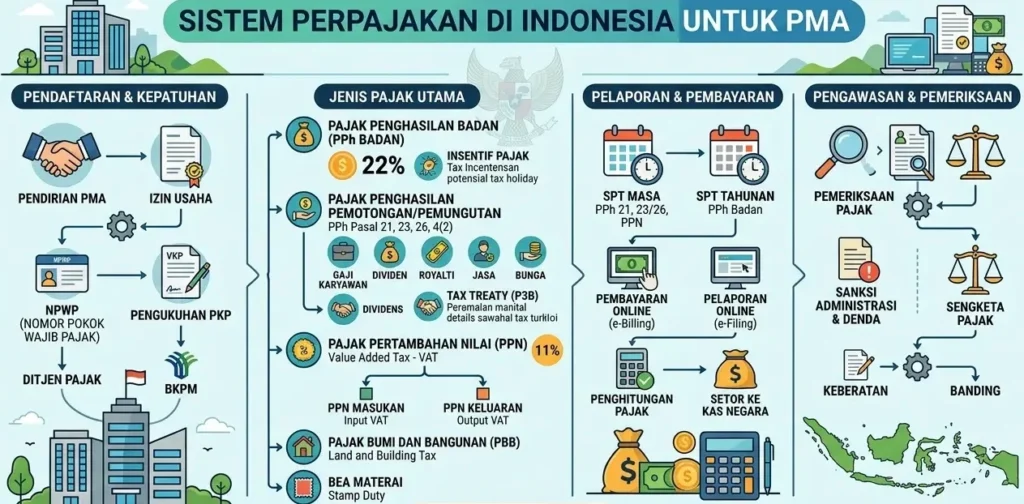


The Tax System in Indonesia for PMA is an important aspect that foreign investors must understand before running a business in Indonesia. For companies with Foreign Direct Investment (PMA) status, understanding the applicable tax regulations is crucial to ensuring smooth business operations and compliance with government rules.
Many foreign investors still do not fully comprehend how the tax system in Indonesia for PMA works. In fact, every PMA company has tax obligations that must be met, ranging from corporate income tax to other business transaction taxes.
By understanding tax for PT PMA, investors can manage tax obligations more effectively while minimizing the risk of errors in tax reporting. Furthermore, a good grasp of the tax system helps companies carry out more effective financial planning.
This article will comprehensively discuss the tax system in Indonesia for PMA, the tax fundamentals foreign investors need to know, and several types of taxes generally applicable to PMA companies.
Getting to Know the Tax System in Indonesia for PMA
Tax System in Indonesia: A Guide for PT PMA
Indonesia applies a tax system that applies to all taxpayers, both individuals and business entities. Specifically for PMA companies, there are several additional provisions to consider.
Fundamentally, the tax system in Indonesia operates on a self-assessment principle. This means the company is independently responsible for calculating, paying, and reporting its tax obligations to the relevant authorities.
The main obligations of a PMA company include:
-
Registering as a taxpayer
-
Calculating taxes independently
-
Making payments in accordance with regulations
-
Submitting tax reports periodically
With this approach, companies are required to be more proactive in managing their tax obligations.
Types of Taxes Applicable to PT PMA
Within the tax system in Indonesia for PMA, there are several types of taxes that generally must be satisfied by companies with Foreign Direct Investment status.
Therefore, understanding these tax types is an essential part of understanding tax for PT PMA, especially for investors who are just starting a business in Indonesia.
Below are several main types of taxes that usually apply.
Corporate Income Tax (PPh Badan)
Corporate Income Tax is one of the primary tax obligations for PMA companies. This tax is imposed on the profits earned by the company within a single tax year.
The Corporate Income Tax rate in Indonesia is generally 22% of taxable income. However, under certain conditions, the government may provide tax incentives for companies that meet specific criteria.
This tax is typically reported in the Annual Corporate Tax Return (SPT Tahunan Badan), which must be submitted every year.
Value Added Tax (VAT / PPN)
VAT is a tax levied on transactions involving the delivery of taxable goods or services in Indonesia. Many PMA companies are required to register as Taxable Entrepreneurs (PKP) if they meet certain criteria.
Some transactions typically subject to VAT include:
-
Sale of taxable goods
-
Delivery of taxable services
-
Import of goods
-
Utilization of offshore services
The VAT rate in Indonesia is currently generally around 11% of the transaction value.
Article 21 Income Tax (PPh Article 21)
Article 21 Income Tax is a tax imposed on income received by company employees. In this case, the PMA company is responsible for withholding the employee’s income tax and remitting it to the state.
Types of income typically subject to Article 21 Tax include:
-
Employee salaries
-
Bonuses
-
Allowances
-
Honorariums
Companies are required to calculate and report this tax every month.
Article 23 Income Tax (PPh Article 23)
Article 23 Income Tax is a tax levied on specific transactions between the company and other parties. This tax usually pertains to payments for services or dividends.
Examples of transactions subject to Article 23 Tax include:
-
Payments for consulting services
-
Royalty payments
-
Dividend distributions to shareholders
Understanding this tax is vital for PMA companies that frequently engage in business collaborations with various parties.
Tax Fundamentals Foreign PMA Investors Need to Know
In addition to understanding the applicable types of tax, foreign investors must also grasp key fundamentals within the Indonesian tax system for PMA.
This understanding helps companies manage their tax responsibilities much better.
Obligation to Have a Tax ID (NPWP)
Every company operating in Indonesia must hold a Taxpayer Identification Number (NPWP). The NPWP serves as the official identity of the company within the tax system.
Without an NPWP, a company cannot carry out various tax obligations, such as:
-
Paying taxes
-
Filing tax reports
-
Applying for tax refunds
Periodic Tax Reporting
Under the tax system in Indonesia for PMA, companies are required to file tax returns periodically to the tax authorities.
Tax filings that must usually be submitted include:
-
Monthly tax returns
-
Annual tax returns
-
VAT returns for PKP
Delays in tax reporting can result in administrative sanctions.
The Importance of Tax Planning
Tax planning is a strategy used by companies to manage tax liabilities efficiently without violating applicable regulations.
By conducting proper tax planning, companies can:
-
Optimize the tax burden
-
Avoid filing errors
-
Enhance corporate financial efficiency
Tax Challenges Frequently Faced by PT PMA
Although the tax system in Indonesia is relatively clear, many PMA companies still face various challenges in fulfilling their tax obligations.
Common challenges include:
-
Fairly dynamic changes in tax regulations
-
Differences between the local tax system and the investor’s home country system
-
Complexity of corporate tax reports
-
Lack of familiarity with local tax regulations
For these reasons, many PMA companies choose to engage tax consultants to assist in managing their tax responsibilities.
layanan konsultan pajak perusahaan
Tips for Managing Taxes for PT PMA
To properly manage tax obligations, PMA companies need to implement several strategic steps.
Here are a few tips to help foreign investors better understand tax for PT PMA:
-
Understand the tax regulations currently in force in Indonesia
-
Keep complete transaction documentation
-
Submit tax returns on time
-
Use an organized accounting system
-
Collaborate with professional tax consultants
By applying these steps, companies can manage their tax obligations far more effectively.
Conclusion
The tax system in Indonesia for PMA is a vital aspect that every foreign investor wishing to do business in Indonesia must comprehend. By understanding the applicable tax rules, companies can ensure that all tax obligations are fulfilled correctly.
Through a solid understanding of tax for PT PMA, companies can avoid tax reporting errors while optimizing business financial management.
regulasi pajak resmi pemerintah
In the end, understanding the tax system is not merely a legal obligation, but also a crucial part of a business strategy that can help a company grow sustainably in Indonesia.